
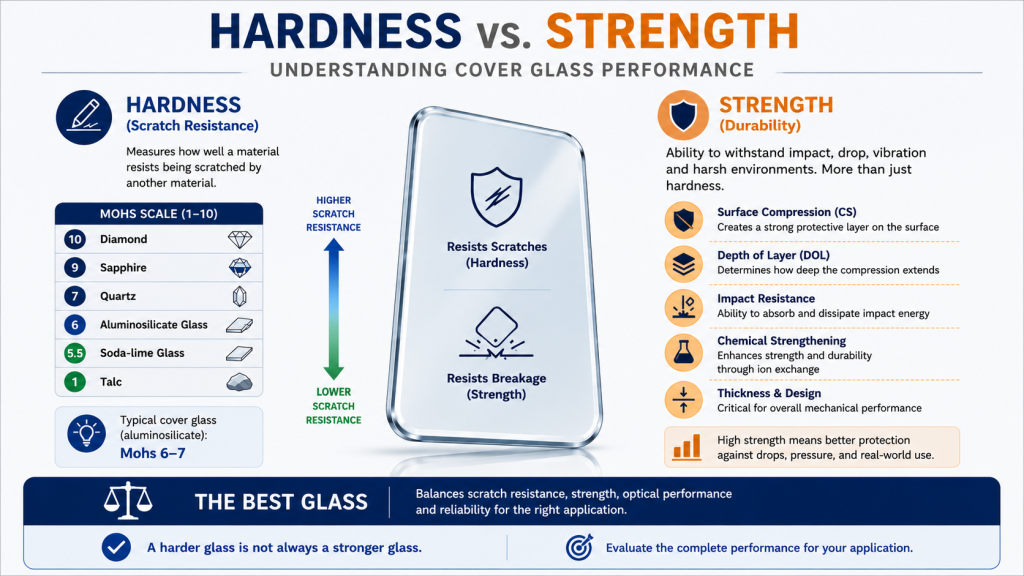
When evaluating cover glass for industrial, medical, automotive, or consumer applications, many people focus on Mohs hardness. While hardness is important, it tells only part of the story.
Mohs hardness measures scratch resistance — how well a material resists being scratched by another material. For example, typical aluminosilicate cover glass has a Mohs hardness of around <6, while sapphire reaches 9.
However, a harder glass does not necessarily mean a stronger glass.
Strength and durability are influenced by other factors, including:
✔ Surface Compression (CS)
✔ Depth of Layer (DOL)
✔ Impact resistance
✔ Chemical strengthening process
✔ Glass thickness and design
In real-world applications, the ability of a glass to survive drops, impacts, vibration, and harsh environments is often more critical than its scratch resistance alone.
When selecting cover glass, it is important to evaluate the complete mechanical performance rather than relying solely on a single hardness value.
The best glass is not always the hardest glass — it’s the one that best balances scratch resistance, strength, optical performance, and reliability for the intended application.
