
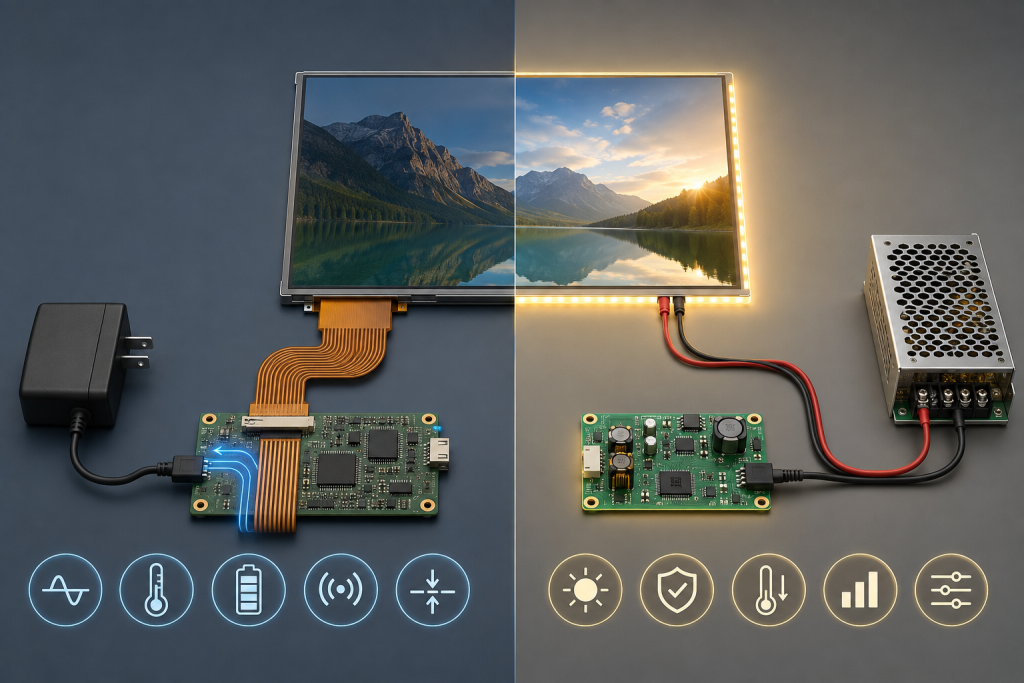
One of the questions I occasionally receive from customers is:
“If the LCD is already connected through the FPC, why can the backlight not simply be powered from there?”
It is a fair question. After all, the FPC already carries the display signals and power, so why introduce another cable, another connector, and another power supply?
The answer lies in engineering rather than convenience.
A display and its backlight have very different power requirements.
The LCD controller, touch panel and display interface (MIPI, LVDS, RGB, etc.) typically consume relatively little current. However, the LED backlight is often the largest power consumer in the entire display assembly.
For example, a high-brightness industrial display may require:
- Display logic: 100–300mA
- Touch controller: less than 50mA
- LED backlight: 500mA to over 3A, depending on brightness
Trying to deliver all of that current through a fine-pitch FPC is not always the best engineering solution.
Why use a separate backlight power supply?
1. Higher current capability
High-brightness displays can easily exceed the current that is practical for an FPC. A dedicated power input allows thicker wires, lower resistance and safer current handling.
2. Reduced voltage drop
Long FPC traces create resistance. As current increases, voltage drops become more significant, causing reduced brightness and inconsistent illumination.
A dedicated power source delivers a more stable voltage directly to the LEDs.
3. Lower heat generation
Higher current flowing through narrow copper traces generates additional heat.
Separating the backlight power keeps temperatures lower, improving both reliability and product lifetime.
4. Better EMC/EMI performance
LED drivers switch current at high frequencies.
Keeping this high-current path separate from sensitive display signals reduces electrical noise and improves signal integrity.
5. Easier brightness control
Many systems use dedicated LED driver ICs that provide:
- PWM dimming
- Analog dimming
- Constant-current regulation
- Open and short LED protection
- Thermal protection
These drivers are usually located close to the main power source rather than inside the display FPC.
6. Greater design flexibility
Different customers have different brightness requirements.
Instead of redesigning the display, engineers can simply choose a different LED driver or power source while keeping the same LCD module.
This approach is particularly useful in medical, industrial and outdoor applications where brightness requirements vary significantly.
Why do consumer devices often use only the FPC?
Phones, tablets and laptops are designed as complete systems.
The display, LED driver, battery and power management IC are all designed together, allowing the backlight power to be integrated into the display connector.
Industrial equipment is different.
Many customers integrate displays into existing systems, each with different power rails, environmental conditions and brightness requirements. A dedicated backlight power supply provides engineers with greater flexibility and a more robust design.
Engineering is about choosing the right solution, not the simplest one.
Adding an extra connector may appear to create unnecessary complexity.
In reality, it is often the decision that improves electrical performance, thermal management, reliability and long-term serviceability.
The next time you see a display module with a separate backlight power input, remember that it is rarely a compromise.
More often, it is the result of thoughtful engineering.
At KANOU, we do not simply supply display modules. We work alongside our customers to recommend the most suitable architecture for each application, whether that means powering the backlight through the FPC or designing a dedicated power solution for higher performance, greater reliability and longer product life.
