
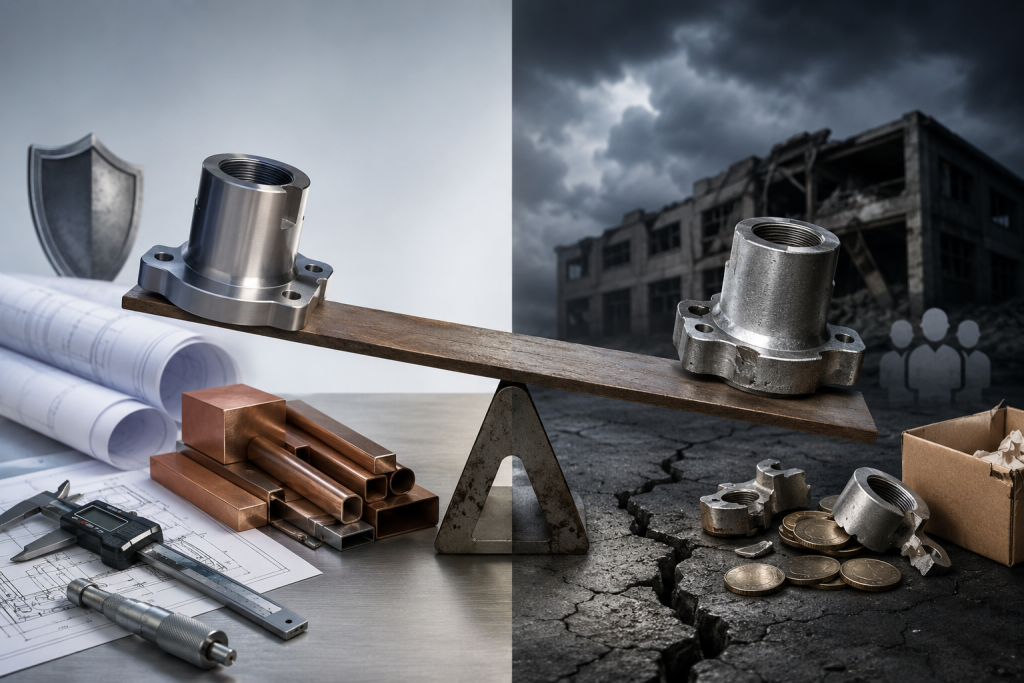
In manufacturing, cost reduction is always important. But there comes a point where we need to ask whether we are reducing cost — or reducing what is actually being supplied.
Depending on the product, raw material can represent a significant portion of the final cost.
Take a few examples:
Machining and sheet metal: Copper is a commodity. If the drawing specifies C10200 or C11000 copper, there is already a real market value attached to the raw material before the first machine starts running.
Cover glass: If the specification calls for genuine Corning® Gorilla® Glass, the substrate itself carries a premium compared with generic alternatives. On top of that come CNC processing, strengthening, printing, coatings, inspection, yield loss and other manufacturing costs. Material and brand can be major cost drivers in custom cover glass.
Yet sometimes we receive a target price that is 50% below a realistic quotation.
That raises an interesting question:
Where is that 50% supposed to come from?
Is the material free?
Has someone discovered a manufacturing process with zero labour, zero machine depreciation, zero electricity and zero rejection?
Or should we be asking a more uncomfortable question:
Is the material actually being supplied the same material specified on the drawing?
This does not mean that every significantly lower quotation is questionable. There can be genuine differences in process efficiency, material utilization, automation, purchasing power, tooling strategy and overhead. A proper should-cost exercise can uncover substantial savings without changing form, fit or function.
But there is a limit.
If Supplier A is quoting $10 and Supplier B is quoting $5, understanding why is far more important than simply celebrating the $5.
And there is another possibility that buyers sometimes overlook:
The supplier may genuinely be selling at a loss.
In difficult markets, some manufacturers accept loss-making orders simply to keep machines running, retain workers and generate short-term cash flow.
That can work — until it doesn’t.
A supplier continuously producing below sustainable cost eventually has limited choices: increase the price, reduce quality, substitute something, delay deliveries, or in the worst case, cease operations.
For a non-critical commodity part, perhaps another supplier can be found quickly.
But what happens when it is a critical component?
A supplier failure can mean:
New supplier qualification. New samples. FAI and validation. Customer approval. Reliability testing. Documentation updates. And, depending on the industry, potentially re-certification or re-approval.
Suddenly, the few dollars saved on each component can become insignificant compared with the cost of qualifying the entire supply chain again.
This is why procurement should never be about finding the lowest number on an RFQ.
It should be about understanding why the number is lower.
There is nothing wrong with challenging a supplier’s price. In fact, we should. Review the material utilization. Challenge the process. Look at tolerances. Consider alternative manufacturing methods. Apply DFM and value engineering.
But once engineering and material economics tell us that something should cost $10, we should understand the engineering behind a $5 quotation before awarding the business.
A sustainable supplier is part of product quality.
Because the true cost of a component is not only what you pay today.
It is also the cost of what happens when your supplier is no longer there tomorrow.
At KANOU, we understand that customers need competitive pricing.
We will challenge our own processes. We will review material utilization, machining strategy, tolerances, manufacturing methods and supply-chain options. We will propose DFM and alternative solutions where they make engineering and commercial sense.
But cost reduction should be engineered — not hidden.
If changing from one material grade to another can reduce cost, we discuss it with the customer.
If a tolerance is unnecessarily tight and driving machining cost, we highlight it.
If another manufacturing process can achieve the same functional requirement more economically, we propose it.
If an alternative glass substrate can meet the actual application requirements, we evaluate it together.
What we should not do is quote according to one specification and quietly manufacture according to another.
For us, being competitive does not simply mean being the cheapest supplier.
It means helping customers achieve the right balance of cost, quality, engineering performance and long-term supply stability.
Because particularly for medical, industrial, semiconductor and other mission-critical applications, you are not simply buying a component.
You are choosing who you trust to remain behind that component throughout its product life.
