
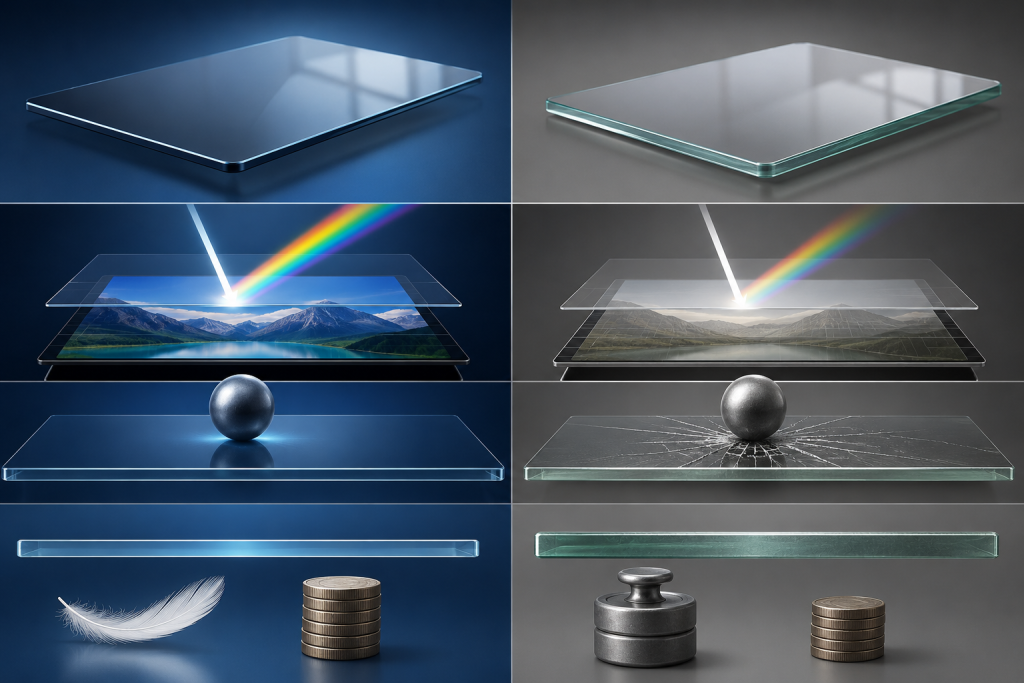
Choosing the right cover glass is important when designing an industrial HMI, medical device, POS terminal or commercial touchscreen. The glass affects not only appearance, but also optical transmission, durability, thickness, weight and overall product cost.
Two common choices are Corning® Gorilla® Glass 3 and conventional soda-lime glass.
Key Comparison

Why Transmission Matters
For touch displays, cover-glass transmission directly affects how much display light reaches the user.
According to Corning’s specification, Gorilla Glass 3 provides ≥91.5% transmission at 0.7 mm thickness.
High transmission can help maintain display brightness and image clarity without requiring the backlight to compensate for excessive optical loss.
However, the final transmission of a touchscreen depends on the complete stack-up, not only the base glass.
For example:
Cover Glass + AG/AR/AF Treatment + Touch Sensor + OCA/OCR + Display
Each layer can influence transmission, reflection, haze and overall readability.
For industrial and medical displays, KANOU therefore recommends evaluating the finished touch-panel optical performance, rather than comparing cover-glass transmission alone.
Why Choose Gorilla Glass 3?
Gorilla Glass 3 is designed for applications requiring a combination of thinness and high damage resistance.
Corning describes the material as providing high resistance to scratches and sharp-contact damage, as well as high retained strength after use.
Corning’s damage-resistance testing also shows that chemically strengthened Gorilla Glass 3 requires a substantially higher critical load to initiate radial cracking compared with chemically strengthened soda-lime glass.
This makes Gorilla Glass particularly attractive for:
- Portable medical equipment
- Industrial handheld devices
- Premium industrial HMIs
- POS terminals
- Commercial touchscreens
- Products exposed to frequent handling
Why Choose Soda-Lime Glass?
Not every application requires specialty glass.
For a stationary industrial HMI or machine-control panel, a thicker soda-lime cover glass may provide sufficient mechanical protection at a lower material cost.
Soda-lime glass can therefore be an excellent choice when:
- Cost is a major consideration
- The equipment is stationary
- Greater glass thickness is acceptable
- Impact requirements are moderate
- Weight and overall thickness are less critical
Choosing the Right Glass Is About the Application
There is no single glass solution that is best for every touchscreen.
Choose Gorilla Glass 3 when thinness, weight reduction and damage resistance are important.
Choose soda-lime glass when cost efficiency is the priority and the required mechanical protection can be achieved with conventional glass.
At KANOU, we support customized cover-glass and touch-panel solutions according to your mechanical, optical and environmental requirements.
Custom Cover Glass • CNC Processing • Decorative Printing • AG Anti-Glare • AR Anti-Reflective • AF Anti-Fingerprint • Touch Panel Integration • Optical Bonding
Have a Drawing or Specification?
Send us your glass drawing, display specification or application requirements, and KANOU can work with you to identify a suitable cover-glass and touch-panel solution for your next industrial, medical or commercial display project.
