
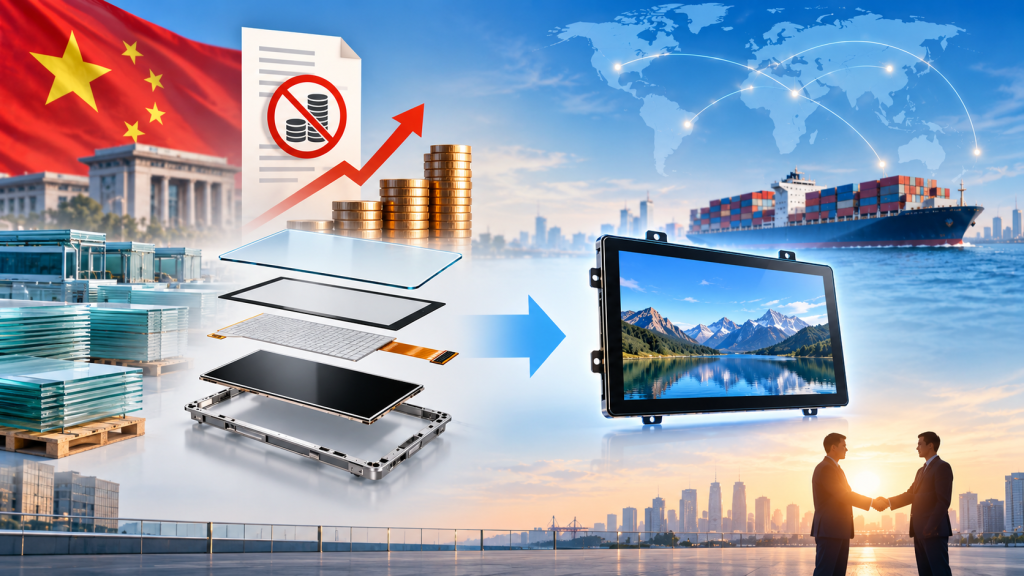
From 1 April 2026, changes to China’s export tax rebate policy have affected certain processed glass products, including categories relevant to cover glass used in touchscreen and display applications.
For many years, export tax rebates formed part of the cost structure for glass products manufactured and exported from China. With these rebates removed for affected products, manufacturers across the industry are facing additional cost pressure.
Naturally, the first question from customers will be:
Does this mean prices have to increase?
The simple answer is that there will be pressure on pricing. However, at KANOU, we believe the conversation should go beyond simply passing additional costs to customers.
Can We Build It Differently?
One interesting aspect of the policy change is that while certain processed glass products are affected, the policy treatment for completed display modules can be different. The analysis prepared by our team notes that qualifying display modules under HS 8524 continue to retain a 13% export rebate.
This creates an opportunity to rethink the traditional supply model.
Instead of purchasing cover glass, touchscreen, LCD and optical bonding separately, could these processes be consolidated into a complete customized touchscreen/display module?
For some projects, moving further up the value chain can potentially provide benefits beyond the tax consideration:
- Fewer suppliers and interfaces to manage
- Reduced logistics and coordination
- Single-point responsibility for the complete module
- Better control over compatibility between glass, touch and display
- Opportunities to optimize the overall product cost rather than focusing only on individual component prices
This is also the direction KANOU has been developing towards — from custom cover glass, to touchscreen integration, optical bonding, and ultimately complete customized display modules.
Look at Total Cost, Not Just Piece Price
When market conditions change, finding another supplier with a lower quotation may appear to be the quickest solution.
But changing a qualified supplier can also involve new samples, engineering evaluation, validation, quality qualification, logistics changes and, ultimately, risk.
That is why we believe procurement decisions should increasingly consider Total Cost of Ownership (TCO) rather than piece price alone. The original analysis similarly highlights qualification, lead-time and quality risks when evaluating alternative sourcing locations.
Turning a Policy Change Into an Opportunity
Tax policies will change. Material costs will fluctuate. Supply chains will continue to evolve.
Our responsibility as a manufacturing partner is not simply to tell customers that “cost has increased, therefore price must increase.”
The more important question is:
Can we redesign the supply chain, consolidate processes, improve productivity or change the way the product is delivered to offset some of that impact?
At KANOU, that is the conversation we want to have with our customers.
From custom cover glass to touchscreen, optical bonding and complete display modules, we continue to look for ways to deliver not just individual components — but a better overall manufacturing solution.
Changing conditions do not always require a more expensive solution. Sometimes, they require a smarter one.
