
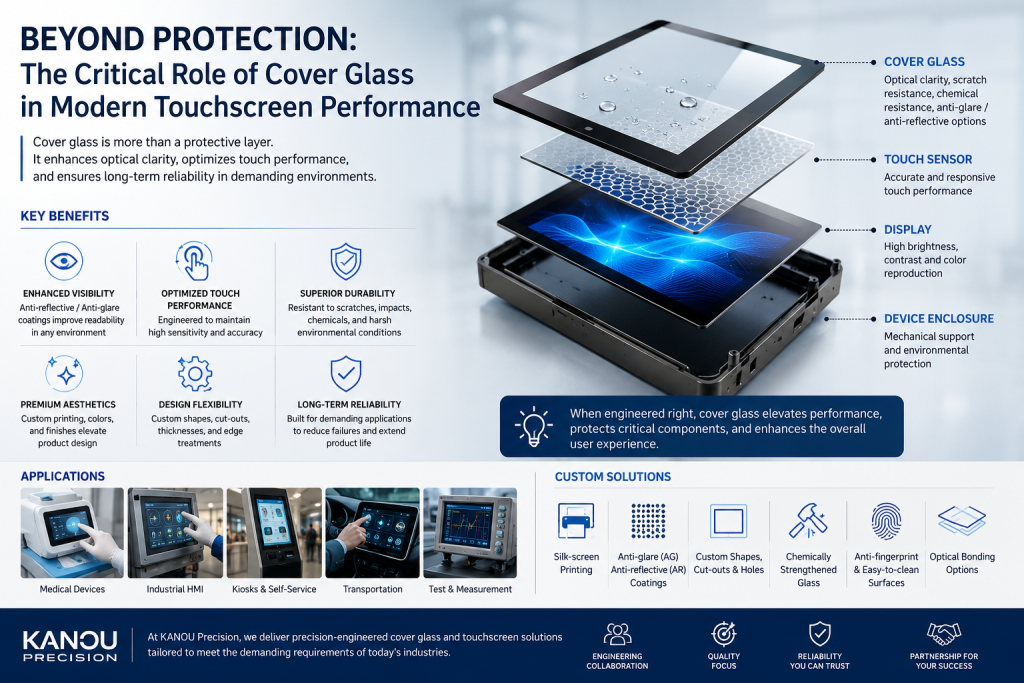
When discussing touchscreens, most attention is given to display resolution, brightness, and touch sensitivity. However, one often-overlooked component has a significant impact on both user experience and product reliability: the cover glass.
Far more than a protective layer, cover glass is an engineered component that influences optical performance, touch functionality, durability, and long-term product reliability.
The Evolution of Cover Glass
In early touchscreen designs, cover glass primarily served as a protective barrier between the user and the display.
Today’s applications demand much more.
Modern cover glass must simultaneously provide:
- High optical clarity
- Excellent touch responsiveness
- Mechanical durability
- Chemical resistance
- Environmental protection
- Premium aesthetics
Whether integrated into a medical device, industrial HMI, self-service kiosk, or commercial equipment, cover glass has become a critical element of the overall system design.
Optical Performance Matters
One of the biggest challenges in touchscreen design is maintaining display visibility under varying lighting conditions.
Poorly designed cover glass can create:
- Excessive reflections
- Reduced contrast
- Lower outdoor readability
- Increased eye fatigue
To address these challenges, manufacturers often implement:
- Anti-reflective (AR) coatings
- Anti-glare (AG) surface treatments
- Optical bonding technologies
These solutions significantly improve display readability while enhancing the overall user experience.
Durability Beyond Scratch Resistance
Many users associate stronger glass with scratch resistance alone. However, durability encompasses much more.
Industrial and medical environments frequently expose touchscreens to:
- Repeated impacts
- Chemical cleaning agents
- Temperature fluctuations
- Humidity
- Dust and contaminants
Selecting the appropriate glass thickness, strengthening process, and surface treatment can dramatically improve product lifespan and reduce field failures.
The Relationship Between Cover Glass and Touch Performance
As touchscreens become more sophisticated, the interaction between cover glass and touch sensors becomes increasingly important.
Thicker glass improves durability but can also affect touch sensitivity.
Engineers must carefully balance:
- Glass thickness
- Sensor design
- Controller performance
- User interaction requirements
Applications involving gloves, water exposure, or harsh environments require particularly careful optimization to ensure reliable touch performance.
Custom Cover Glass: More Than Just a Shape
Many OEMs now require custom cover glass solutions that align with their product branding and functional requirements.
Customization options may include:
- Silk-screen printing
- Custom colors and logos
- Specialized coatings
- Edge treatments
- Hole drilling and cut-outs
- Surface texturing
These features help manufacturers differentiate their products while maintaining performance and reliability.
Future Trends in Touchscreen Design
As industries continue moving toward smarter and more connected devices, cover glass technology is evolving to support:
- Larger interactive displays
- Outdoor readability improvements
- Antimicrobial surfaces
- Enhanced impact resistance
- Seamless industrial design integration
The demand for durable, visually appealing, and highly responsive touchscreen interfaces will continue to grow across industrial automation, medical equipment, transportation, and commercial applications.
Final Thoughts
A touchscreen’s performance is determined by more than the display or touch sensor alone. Cover glass serves as the critical interface between technology and the user.
When properly engineered, it enhances visibility, improves reliability, protects sensitive electronics, and elevates the overall user experience.
At KANOU, we work closely with customers to develop cover glass and touchscreen solutions that meet the demanding requirements of today’s industrial, medical, and commercial applications.
Because in modern product design, every layer matters.
