
When selecting a projected capacitive (PCAP) touchscreen for industrial, medical, commercial, or embedded applications, one of the most common questions is:
Should I choose GG or GFF touch technology?
While both technologies provide multi-touch capability and excellent user experience, their construction, durability, optical performance, and cost differ significantly.
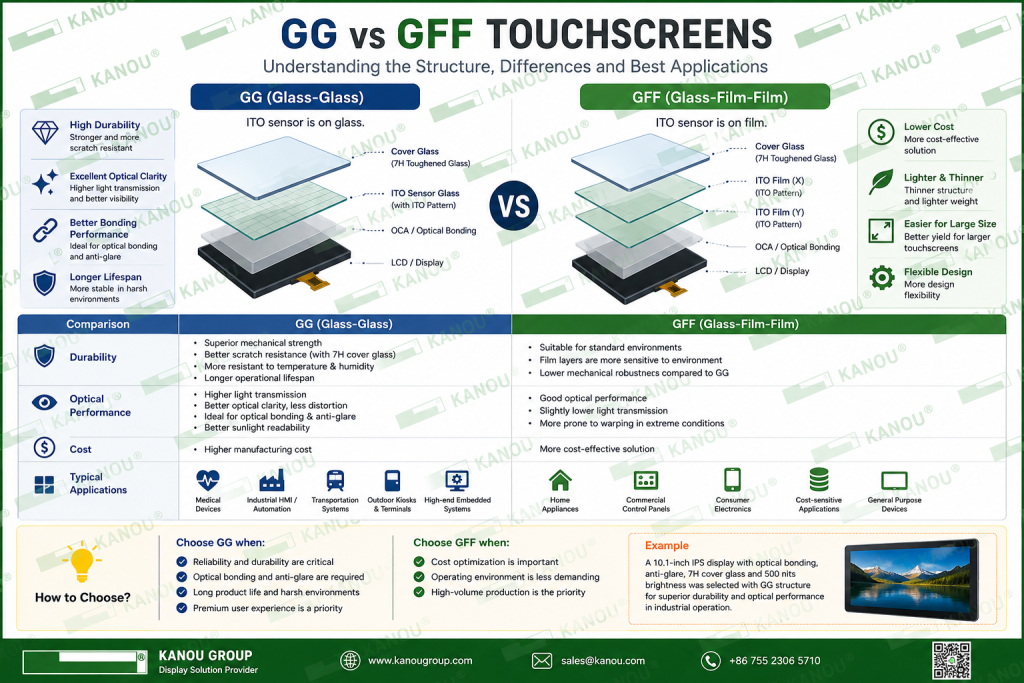
Understanding the Structure
GG (Glass-Glass)
GG stands for Glass-Glass construction.
The touchscreen consists of:
Cover Glass
ITO Sensor Glass
In this design, the conductive ITO (Indium Tin Oxide) sensor is deposited directly onto a glass substrate.
GFF (Glass-Film-Film)
GFF stands for Glass-Film-Film construction.
The touchscreen consists of:
Cover Glass
ITO Film Layer
ITO Film Layer
Instead of glass, the touch sensor is created on PET film layers.
Key Differences
1. Durability
GG
✔ Superior mechanical strength
✔ Better scratch resistance
✔ More resistant to temperature and humidity variations
✔ Longer operational lifespan
GFF
✔ Suitable for standard environments
✖ Lower mechanical robustness
✖ Film layers may be more susceptible to environmental stress over time
For industrial, medical, transportation, and outdoor applications, GG is often the preferred choice.
2. Optical Performance
GG
✔ Better optical clarity
✔ Lower risk of warping
✔ Excellent compatibility with optical bonding
✔ Improved sunlight readability
GFF
✔ Good optical performance
✖ Slightly lower light transmission compared to GG
✖ More susceptible to dimensional changes under extreme conditions
When combined with optical bonding and anti-glare treatment, GG generally delivers the best viewing experience.
3. Cost
GG
Higher manufacturing cost due to glass-based sensor construction.
GFF
More cost-effective solution for high-volume applications.
For projects where budget is the primary concern, GFF can provide an attractive alternative.
4. Typical Applications
GG Touchscreens
Medical devices
Industrial HMI panels
Factory automation equipment
Outdoor kiosks
Transportation systems
High-end embedded displays
GFF Touchscreens
Consumer electronics
Smart home appliances
Commercial control panels
Cost-sensitive embedded products
Which Technology Is Better?
The answer depends on the application’s priorities.
Choose GG when:
Reliability is critical
Optical bonding is required
Long product life is expected
Harsh environments are involved
Premium user experience is desired
Choose GFF when:
Cost optimization is important
The operating environment is less demanding
High-volume production is the priority
Final Thoughts
As display technologies continue to evolve, touchscreen performance is becoming increasingly important in industrial and embedded systems.
For applications requiring high durability, superior optical performance, and long-term reliability, GG remains the industry benchmark.
However, GFF continues to offer an excellent balance between performance and cost, making it a practical choice for many commercial applications.
The best solution is not always the most expensive one—it is the one that best matches your application’s requirements.
What touchscreen structure are you currently specifying for your projects: GG or GFF?
#Kanou #customtouchscreen #customcoverglass #GorillaGlass #GFF #ggtouchscreen #gfftouchscreen
